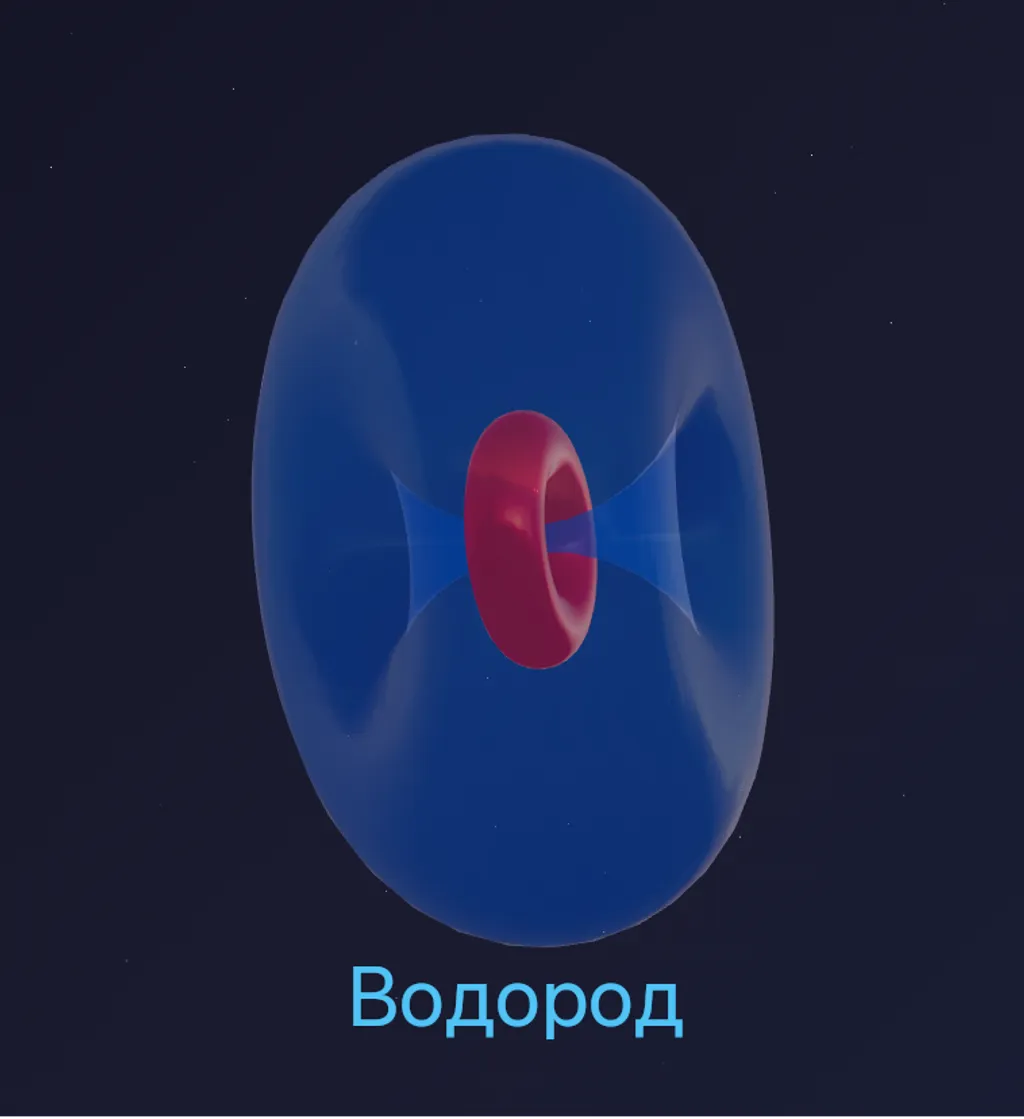
Atomic Structure. Aether Dynamics. Part 1
This is the first article in the series. More materials will follow, in which we will step by step develop and refine the model of matter structure — from elementary particles to atomic nuclei and molecules. Stay tuned.
About the Series
This series is dedicated to developing the theory of aether dynamics established by Vladimir Akimovich Atsyukovsky (1930–2021) — a Russian engineer and researcher, author of the foundational work “General Aether Dynamics. Modeling the Structure of Matter and Fields Based on the Concept of a Gas-Like Aether.” In his work, Atsyukovsky treated the aether as a real, viscous, compressible gaseous medium, and elementary particles as stable vortex formations within that medium. His ideas continue to inspire researchers around the world.
Video lectures by Vladimir Akimovich are available on his YouTube channel. In parallel, Dmitry Losinets does significant work popularizing and developing these ideas — his channel: Aether Dynamics on YouTube.
The goal of this series is not merely to present existing models, but to critically examine them, identify weaknesses, and propose refinements. This is a living investigation, not a textbook.
Introduction
This article is an attempt to understand what atoms actually look like and how they function. It draws on the research of many scientists — both those recognized by the mainstream scientific community and those still little known to the general public.
I paid particular attention to the work of Dmitry Losinets, who has done enormous work resulting in a compelling “Theory of Everything.” The author himself acknowledges that certain parts of the model require further development. For instance, when I saw how he depicts the alpha particle, I had doubts about the mechanical stability of such a structure. Yet numerous experiments show that the alpha particle is exceptionally stable and serves as the primary “building block” for heavier atomic nuclei.
🌀 Foundations of Aether Dynamics
Let’s start from the beginning. According to the aether dynamics model, protons, neutrons, and electrons are toroidal formations composed of aether.
“Aether is a nearly superfluid medium in which particles, fields, and forces emerge as vortex structures.”
— D. Losinets
This is roughly what a proton might look like:
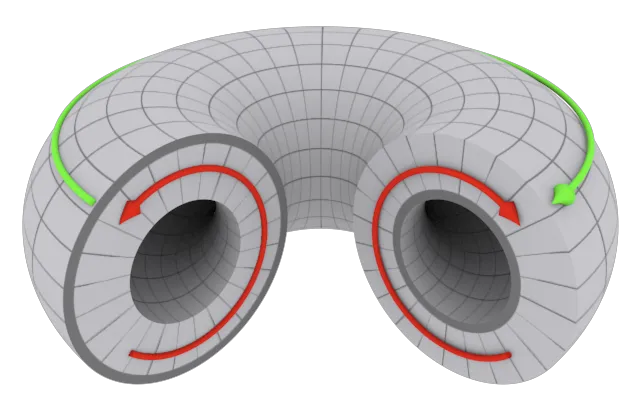
“The proposed physical model of an elementary particle within the aether dynamics framework is a toroidal aether vortex possessing both ring and toroidal rotation, or a combination of such vortices.”
— D. Losinets
A neutron differs from a proton by having an additional layer of aether that significantly changes the particle’s properties. This extra layer stops the independent absorption of aether through the inner hole of the torus, which is what ensures the particle’s electrical neutrality. However, aether does pass through the neutron’s inner hole when there is a pressure difference between opposite sides — according to Bernoulli’s law. This is critically important for understanding how atoms are formed.
🔬 Direct Observation of the Electron Orbital
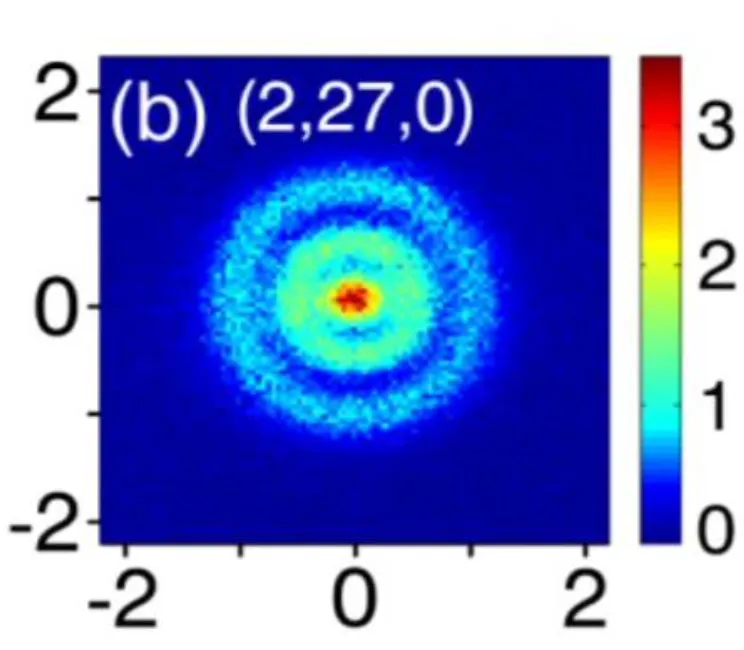
This concerns the first-ever “direct observation” of the electron orbital of a hydrogen atom.
Who Conducted the Experiment and When
The study was carried out by a group of scientists from the Institute for Atomic and Molecular Physics (AMOLF) in the Netherlands. The results were published in the prestigious journal Physical Review Letters in 2013 (PhysRevLett.110.213001).
How It Works
The scientists used a photoionization microscope. The experimental procedure was as follows:
- A hydrogen atom was placed in a strong electric field.
- The atom was then irradiated with laser pulses to excite the electron.
- The excited electron left the atom and was recorded by a detector.
The red regions in the resulting image correspond to the highest probability of ejecting an electron; the violet regions correspond to the lowest.
Mainstream science interprets these results using quantum mechanics.
💡 Aether Dynamics Interpretation (Hypothesis)
While quantum mechanics describes the electron as a “probability cloud” or wave function with no definite spatial structure, the aether dynamics model proposes treating it as a real physical object governed by the laws of gas dynamics.
Nature and Origin of the Electron
Within this hypothesis, the electron is a toroidal aether vortex. It is not a static formation but a dynamic process: a flow of aether is continuously expelled from the nucleon (nucleus), makes a loop-like motion, and is drawn back in.
This approach changes our understanding of how an atom forms:
- Generation, not capture. The electron does not need to arrive from outside to be captured by the nuclear field. It is generated by the nucleus itself.
- A unified system. Since the electron is a flow of aether, it is a direct consequence of the nucleon’s internal structure. Once a nucleus forms, it inevitably creates vortex shells (electrons) around itself as a result of the medium’s circulation.
Thus, the electron is the “breath” of the nucleus — its inseparable dynamic component, having significantly lower density and greater volume compared to the nucleon itself.
Analysis of the Experiment
The “photo” of the atom presented by the scientists receives a logical explanation through vortex mechanics:
- Vulnerability of the center. The image shows that disruption of the structure (electron ejection) is most effective when the central region is targeted. In the toroidal vortex model, the center is the axis of flow circulation — where the densest and fastest aether flow passes, connecting the vortex periphery to the nucleus.
- Stability of the periphery. The outer part of the torus (the electron “body”) has low density. Energy impact on this area passes through the rarefied medium without disrupting the overall stability of the system.
- Mechanism of destruction. A point impact at the geometric center interrupts the main circulation channel (the flow inlet/outlet), causing the entire vortex formation to instantly collapse.
This supports the hypothesis that the electron has a complex internal topology with a distinct axial channel, rather than being a homogeneous probability cloud.
🧩 The Question of the Alpha Particle
Now let’s return to the alpha particle. In Dmitry Losinets’s book “All of Physics in 100 Pages,” it is depicted as a combination of nucleons. Looking at that diagram, I had doubts about the mechanical strength of such a structure.
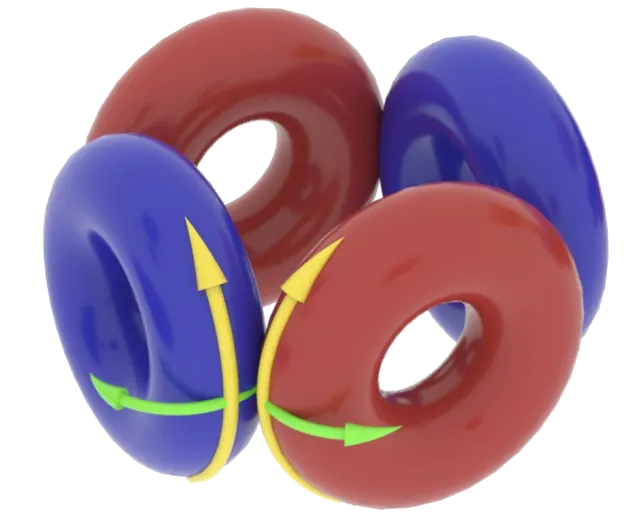
This doubt is reinforced by the fact that the alpha particle is an exceptionally stable formation. It is precisely the “building block” actively used in forming heavier atomic nuclei.
Do you think such a structure can provide the necessary stability? This question will be the starting point for Part 2 of the series.
To be continued. In Part 2, we will examine the structure of the alpha particle in more detail and attempt to propose a more stable configuration.