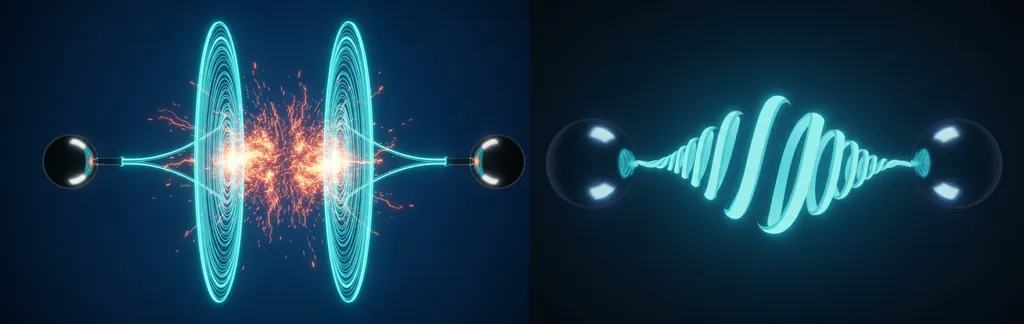
Charge and Magnetism: Two Faces of One Vortex. Part 23
“Electricity and magnetism are not two forces, but two aspects of the same phenomenon.”
— Michael Faraday
🎯 Purpose of the Article
In previous parts of the series, we examined the structure of the proton, electron, and neutron, built models of atomic nuclei, and explained gravity as an ether flow. But one of the main questions remained open: what is electric charge?
Standard physics says: “Charge is a fundamental property of a particle.” But this is not an answer; it’s a label. We want to understand the mechanism: why do like charges repel and opposite charges attract?
Today we will:
- Propose a mechanical explanation of charge.
- Show why the “source/sink” model does not work.
- Examine the working model: charge = chirality (direction of rotation) of a vortex.
- Explain permanent magnets without invoking quantum mechanics.
⚠️ The Trap: The “Fountain and Funnel” Model
The first thing that comes to mind: a positive charge is a “fountain” (ether source), a negative charge is a “funnel” (ether sink). See more details in Article 7:
Let’s test this idea on three cases:
Case 1: Opposite charges (+ and -)
   [+] ──ether──►  ──ether──► [−]
 fountain                   funnel
The fountain drives ether to the funnel. A directed flow arises, which drags both bodies toward each other → attraction ✅
Case 2: Two positives (+ and +)
   [+] ──ether──►  ◄──ether── [+]
 fountain          💥        fountain
Two opposing fountains collide, creating a high-pressure “cushion” → repulsion ✅
Case 3: Two negatives (- and -)
   [−] ◄──ether──  ──ether──► [−]
 funnel                     funnel
Two funnels side by side. The pressure between them drops; both pull ether toward themselves. But then the external ether pressure should squeeze them together → attraction ❌
Problem! The “fountain/funnel” model predicts that two negative charges should attract. But experiment shows the opposite.
This is a classic trap of ether models of charge. We need another idea.
💡 Working Model: Charge = Chirality of Rotation
Let’s return to our proton model. It is a toroidal vortex with two rotations:
- Toroidal — the ring rotates around its central axis.
- Poloidal — the “skin” of the donut turns inside out.
These rotations set the direction of the spiral of the ether flow around the particle. And this direction can be right-handed or left-handed, like the thread on a bolt.
Definition:
Positive charge (+) — a vortex with right-handed chirality (a right-hand “screw”).
Negative charge (−) — a vortex with left-handed chirality (a left-hand “screw”).
Charge is not “something being ejected” or “something being sucked in.” Charge is which way the ether vortex rotates. Plus and minus are right and left.
🔬 How Chirality and Bernoulli’s Principle Explain Charges
Let’s imagine elementary particles as toroidal vortices (donuts) approaching each other side-by-side. Ether is a gaseous medium, which means classical laws of hydrodynamics apply here, primarily Bernoulli’s principle: where the flow velocity is higher, the pressure of the medium drops, and vice versa.
Let’s see what happens in the gap between two approaching tori depending on their chirality (direction of rotation).
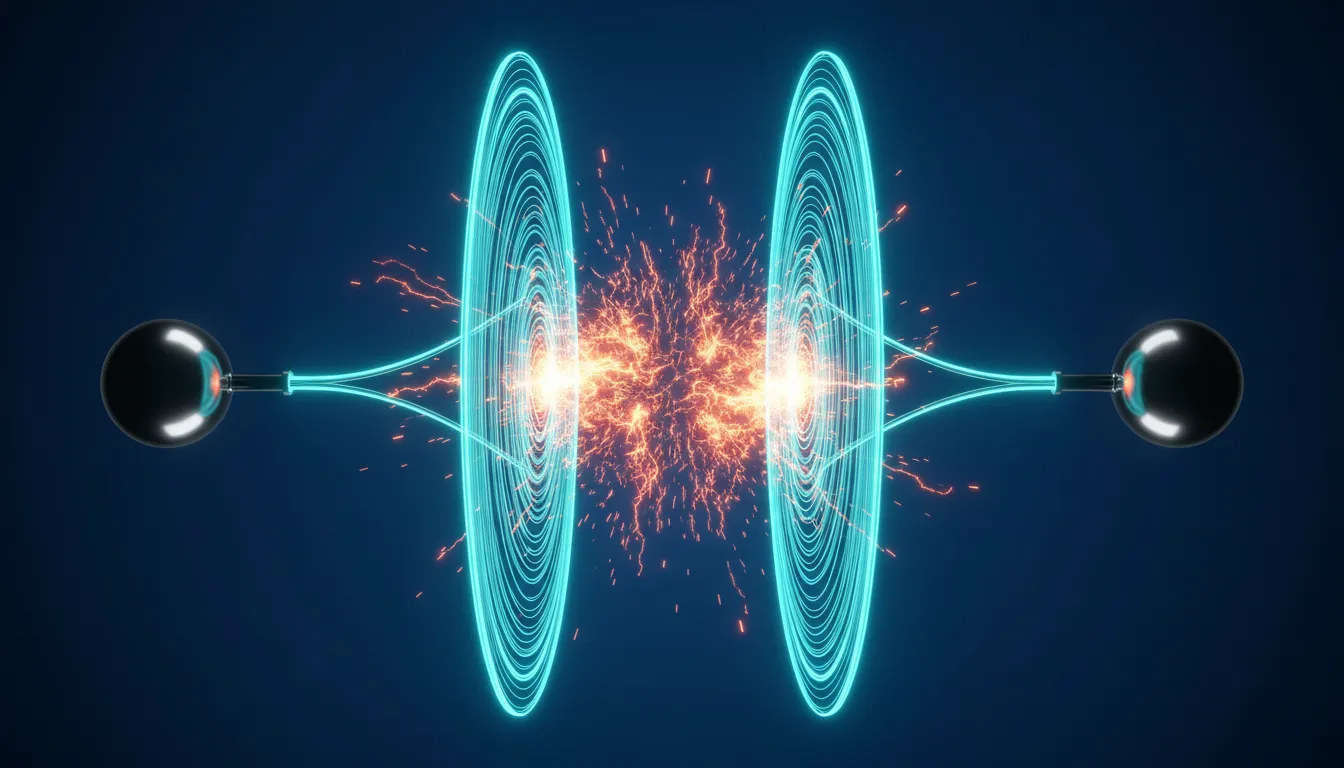
Case 1: Like charges (+ and +) or (− and −)
Co-rotation → Opposing flows → Repulsion
If two vortices have the same chirality (both right or both left), they rotate in the same direction. When they approach side-by-side, the ether flows on their outer edges in the contact zone are directed against each other.
The opposing flows collide in the narrow gap. The velocity of the ether here drops sharply (the flows decelerate each other). According to Bernoulli’s principle, a drop in velocity leads to an increase in pressure. An elastic high-pressure ether cushion arises between the particles, which pushes them apart. This is Coulomb repulsion.
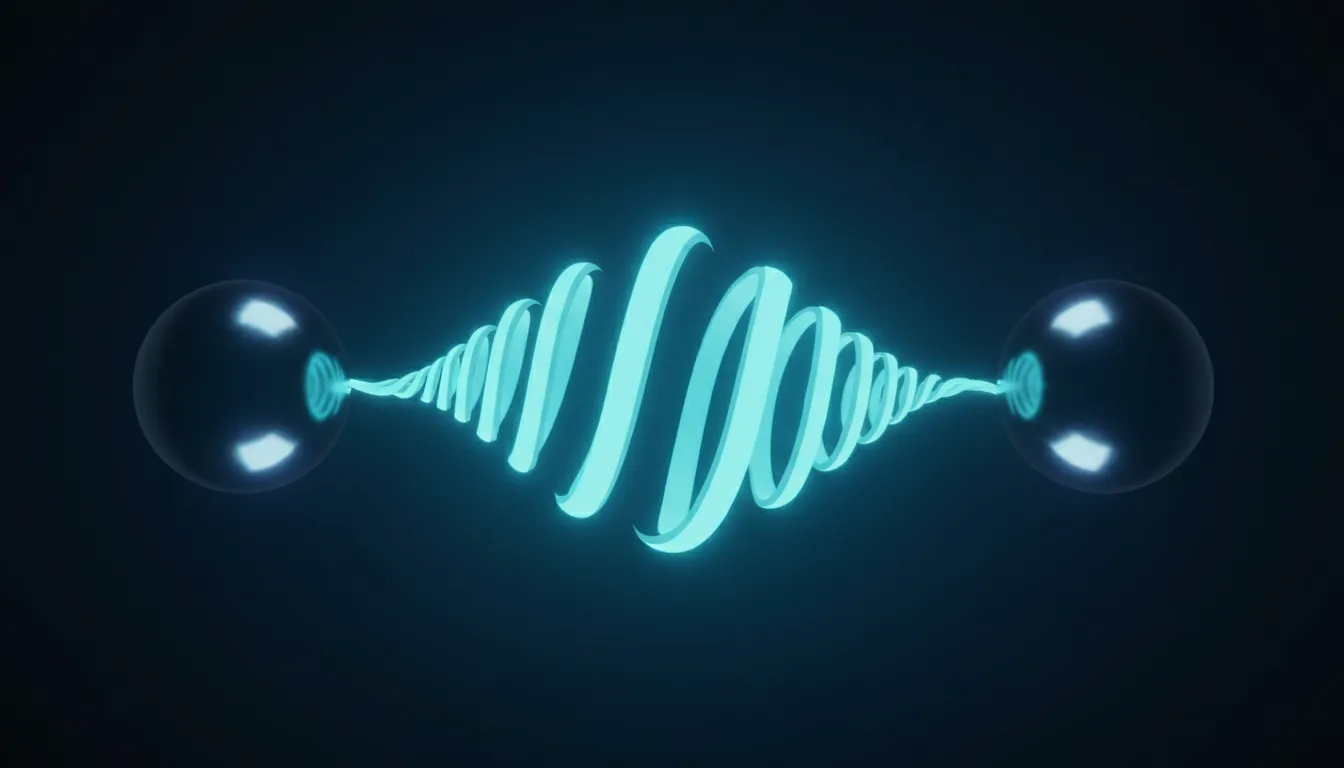
Case 2: Opposite charges (+ and −)
Counter-rotation → Coherent flows → Attraction
If the vortices have different chiralities (one right, one left), they rotate in opposite directions. In the zone where they approach, the ether flows travel in the same direction.
The flows do not collide but merge; their velocities add up. The ether in the gap begins to flow faster than outside. According to Bernoulli’s principle, a sharp increase in velocity causes a drop in pressure between the particles. A rarefaction zone arises. The external, undisturbed ether pressure from all sides begins to squeeze these two vortices toward each other. This is Coulomb attraction.
All three cases work perfectly: continuum mechanics describes what physicists call electrostatics without invoking any magical forces.
⚖️ Neutrality: Compensated Rotations
Recall our neutron model from Article 10:
Neutron = Proton + Electron (in a compressed state)
The proton is a right-handed vortex (+). The electron is a left-handed vortex (−). When the electron is compressed around the proton, the opposite rotations compensate for each other. The result is a neutral particle.
In a neutral atom, each proton in the nucleus generates an electron vortex with opposite chirality. As long as all electrons are in place, the total chirality is zero.
Where does the charge of a body come from?
- Lost electrons → uncompensated right-handed vortices remain → body is charged positively
- Gained extra electrons → uncompensated left-handed vortices appear → body is charged negatively
✨ Annihilation and the Paradox of Scale
If opposite charges (+ and −) attract due to hydrodynamics, then what happens when they collide? Here we encounter two completely different scenarios, explained purely by the geometry and density of the vortices.
Scenario 1: Electron and Positron (Annihilation)
The electron (left-handed vortex) and positron (right-handed vortex) are particles with absolutely identical sizes, mass, and density. They are perfect mirror twins.
When hydrodynamic attraction causes them to collide head-on, their geometry matches perfectly. The coherent ether flows completely “short-circuit” each other; the structure of both tori is destroyed due to mutual cancellation of their axes. Both vortices decay (collapse), and the colossal energy of their rotation is released into the surrounding ether as powerful longitudinal compression waves — gamma quanta. The vortices have destroyed each other.
Scenario 2: Proton and Electron (Stable Pair)
A logical question arises: if the proton (+) and electron (−) have different chirality and also attract, why don’t they annihilate inside the hydrogen atom or neutron?
The answer lies in scale. In our etherodynamic model, the proton is a tiny, extremely massive, and dense ether vortex. The electron, on the other hand, is a diffuse, enormous (in volume) entity with very low density.
Due to the colossal difference in size and pressure, a head-on cancellation of flows is impossible. The loose electron is physically incapable of destroying the monolithic structure of the proton. Instead of annihilation, integration occurs:
- In the case of the hydrogen atom, the electron establishes a stable macroscopic circulation around the proton at a distance where the flow pressures balance out.
- In the case of the neutron (under extreme pressure), the electron literally “wraps” around the proton, enveloping it and compensating its chirality outward. The structure is preserved, but the external manifestation of charge is zeroed out.
No quantum magic — just hydrodynamics, where the outcome of a collision depends on the density and dimensions of the colliding vortices.
📏 Coulomb’s Law: Why 1/r²?
The force of interaction between charges decreases as the square of the distance: .
In our model, this has a simple geometric explanation. The vortex creates a disturbance in the surrounding ether. This disturbance propagates radially in all directions. At a distance from the charge, the disturbance is “smeared” over a sphere with an area of .
The further away, the larger the area of the sphere, and the weaker the disturbance per unit area. Hence, is not a mysterious formula, but the geometry of a sphere.
🔮 What Does a Charged Macrobject Look Like?
Until now, we have been talking about individual vortices. But how does charge manifest at the level of a real body — a metal ball or a glass rod? And why, as experiments show, does a ball have the same charge from any side?
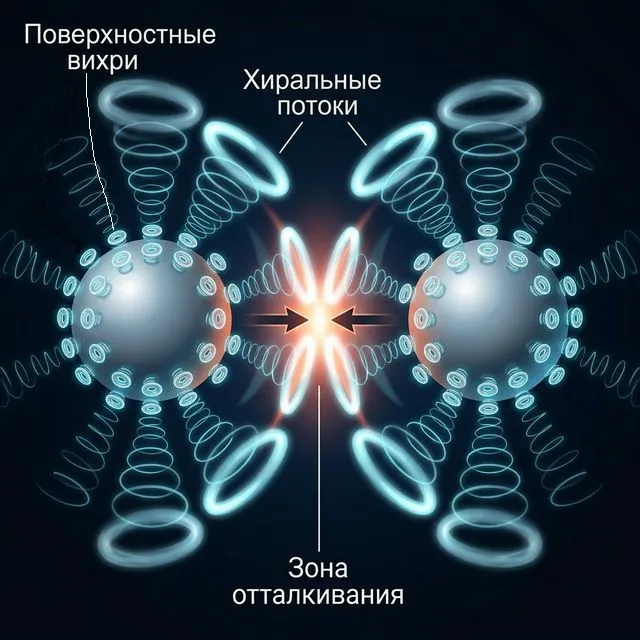
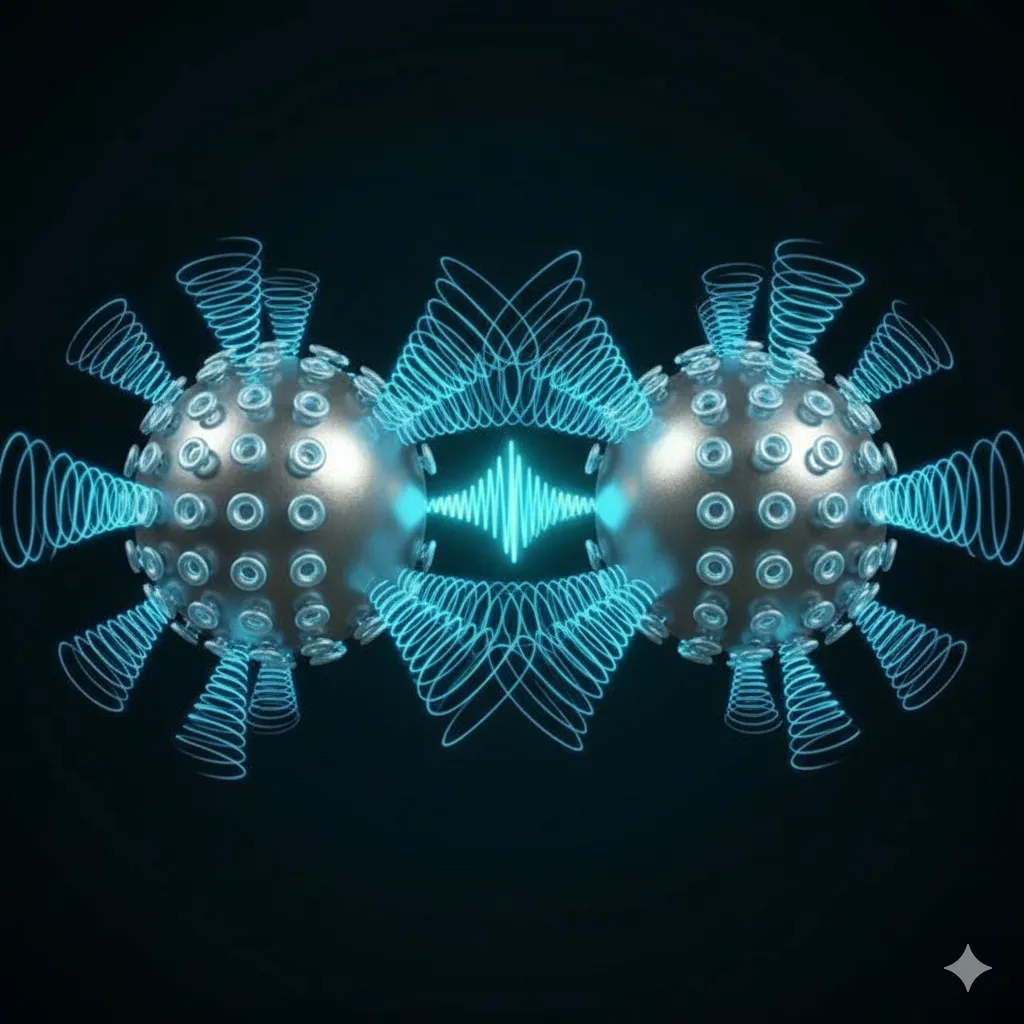
When a macro-object receives a static charge, this charge is always concentrated on the very surface of the body. Surface atoms rearrange their ether shells so that millions of microscopic vortices stick out of the material, with their axes aligned perpendicular to the surface.
The Ball as a “Dandelion of Tornadoes”
Imagine a sea urchin or a fluffy dandelion. Only instead of needles or fluff, microscopic ether tornadoes stick out radially in all directions from the surface of the charged ball.
- If the ball is charged positively, its surface is covered with millions of rotating fountains (they shoot a flow of ether outward, spiraling in a specific direction).
- If the ball is charged negatively, millions of rotating funnels form on the surface of the ball (they spirally draw ether into themselves, rotating in the opposite direction).
Since these tornadoes (fountains or funnels) dot the entire area of the ball and stick out of it in all directions, the charge is isotropic — from whichever side you bring another body to the ball, it will be met by an identical “bristle” of these rotating micro-tornadoes.
This “aura” of millions of rotating flows on the surface is exactly what classical physics calls an “electrostatic field.”
Encounter of Two Macro-objects: Head-On
Now let’s see what happens when we bring two such “fluffy” charged balls close together. The tornadoes on their facing surfaces meet tips first (head-on). We apply Bernoulli’s principle:
Case 1: Like charges (+ and +) or (− and −)
Both balls are covered with tornadoes of the same chirality. But since they are facing each other, looking from the outside, their rotations in the contact zone are directed against each other. (Imagine two identical screws that you are trying to connect point-to-point — their threads don’t match).
The ether flows on the edges of these tornadoes strike each other.
Result: Flow velocity in the gap drops → ether pressure rises sharply. An elastic ether cushion arises between the balls, pushing them apart. This is macroscopic repulsion.
Case 2: Opposite charges (+ and −)
Tornadoes on one ball are right-handed, on the other — left-handed. When they meet tips first “head-on”, the opposite spin causes their peripheral flows in the contact zone to flow in the same direction. They mesh perfectly, like gears.
Result: Flows merge → ether flow velocity in the gap rises sharply → pressure of the medium drops. The low-pressure zone causes the external, undisturbed ether pressure to forcefully squeeze the balls together. This is macroscopic attraction.
🧲 From Charge to Magnetism
So, every proton is a rotating vortex continuously pumping ether through itself. In essence, every proton is a tiny permanent magnet, because a rotating vortex creates a microscopic contour of ether circulation around itself.
Then the correct question is not “where does magnetism come from?”, but “why are most materials NOT magnets?”
Ordinary material (copper, glass):
  ↗ ↙ → ← ↑ ↓ ↘ ↗ ←
  ← ↑ ↓ ↗ ↙ → ↘ ↑ ↓
  ↘ → ← ↑ ↗ ↙ ↓ ← ↑
The axes of the atomic vortices are directed randomly. Every atom-pump pumps ether, but all in different directions. The net effect: zero.
Analogy: a million small fans, each blowing in a random direction. There is no wind in the room.
Permanent magnet (iron):
  → → → → → → → → →
  → → → → → → → → →
  → → → → → → → → →
The axes of the vortices are aligned along a common axis. All micro-circulations add up into one. The result is a macroscopic flow of ether.
Analogy: all fans turned to face the same way. Wind!
🔩 Why is Iron a Magnet, but Copper is Not?
It might seem that ferromagnets are unique because their atoms couple through “fountain → funnel” flows. But this is not the case! All crystalline materials hold together through the coupling of ether flows — we examined exactly this in Article 7 about the “pipeline system of matter”. The “fountain → funnel” links are exactly what holds the atoms in the lattice.
So what’s the difference?
The Key Difference: Freedom of Rotation
In most materials (copper, glass, diamond), the ether links between atoms rigidly fix the orientation of the vortex axes. The atoms are solidly “welded” to each other in specific directions. It is impossible to turn the vortex axis of one atom without breaking the bonds. It’s like a bolt screwed tightly into a nut: it’s coupled, but you can’t turn it independently.
In ferromagnets (iron, cobalt, nickel), the situation is different. Their electron (vortex) shell is structured such that the axis of the atomic vortex can rotate without breaking the bonds with its neighbors. The bonds exist, but they are flexible — like a ball joint instead of a weld.
The Mechanism:
- The atoms in the lattice are coupled by flows, but the coupling allows for the rotation of the vortex axis.
- When one atom turns, its “fountain” begins to align better with a neighbor’s “funnel” → the neighbor turns as well.
- The effect cascades → all atoms in the region align → a magnetic domain is born.
Analogy: imagine two types of building sets. In one, the pieces are connected by rigid rivets — it is impossible to turn a single piece. In the other, they use ball joints: the pieces are connected but can rotate. Only the second set can “align” in an external field.
🧱 Magnetic Domains
Even in iron, atoms do not align all at once. The material is divided into domains — regions with the same orientation.
Unmagnetized iron:
  ┌──→──┐┌──↓──┐┌──←──┐
  │  →  ││  ↓  ││  ←  │
  └─────┘└─────┘└─────┘
  ┌──↑──┐┌──→──┐┌──↓──┐
  │  ↑  ││  →  ││  ↓  │
  └─────┘└─────┘└─────┘
Inside each domain, the atoms are aligned. But the domains themselves are directed differently → total magnetism ≈ 0.
Magnetization:
We place the iron in an external directed ether flow (an external magnetic field):
- Domains with the “right” orientation strengthen — the external flow feeds them.
- They grow at the expense of neighboring domains.
- Gradually, all domains align → the material is magnetized:
  ┌──→──┐┌──→──┐┌──→──┐
  │  →  ││  →  ││  →  │
  └─────┘└─────┘└─────┘
  ┌──→──┐┌──→──┐┌──→──┐
  │  →  ││  →  ││  →  │
  └─────┘└─────┘└─────┘
🌀 Two Poles: Topology of the Torus
When all atomic vortices are aligned along a common axis, a macroscopic contour forms.
- North Pole — the zone where ether exits the magnet (the total “fountain”).
- South Pole — the zone where ether enters the magnet (the total “funnel”).
- Magnetic lines — the trajectories of the return flow of ether from N to S.
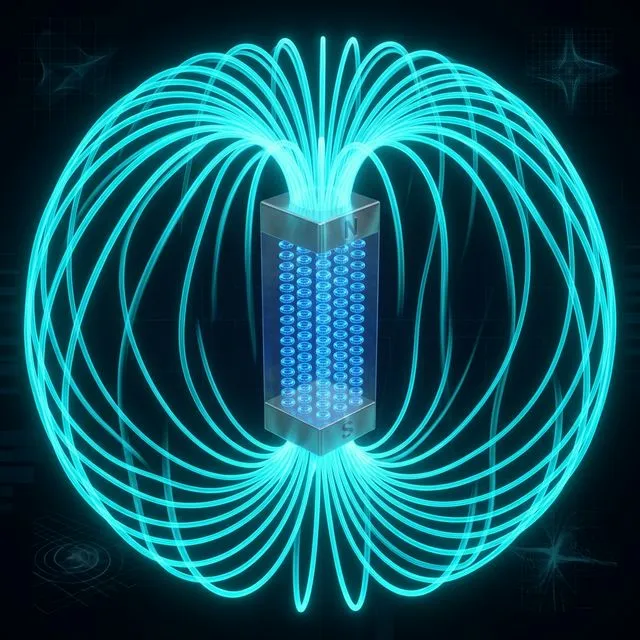
A magnetic field is a macroscopic circulation of ether created by the coherent addition of the individual atomic vortices.
🚫 Why is a Magnetic Monopole Impossible?
In standard physics, the impossibility of a magnetic monopole is an empirical fact without explanation. In our model, it is a topological necessity:
A toroidal vortex is a closed loop. It cannot have only one end. A “fountain” without a “funnel” is ether that has nowhere to return to.
Cut a magnet in half — each half will create its own complete circulation loop. You get two magnets, each with two poles. Because a vortex is always closed.
🌡️ Curie Temperature: When Vibrations Defeat Order
When heated, the atom-pumps oscillate more strongly (we covered this in Article 11 on Brownian motion). At a certain temperature — the Curie temperature — the vibrations become so strong that they tear apart the interatomic “locks”.
| Material | Curie Temperature |
|---|---|
| Iron (Fe) | ~770 °C |
| Cobalt (Co) | ~1115 °C |
| Nickel (Ni) | ~358 °C |
Above this temperature, the vortex axes crumble back into chaos → magnetism disappears. Cool it down — and the domains can align once again (if there is an external field).
🔗 The Electromagnet: Checking for Consistency
The electromagnet is the perfect test for the model. If our picture is correct, then a coil with current should create the exact same phenomenon as a permanent magnet.
- Current in a wire is a directed flow of ether (Article 7).
- A wire coiled into a loop is a spiral flow.
- A spiral flow = a multitude of parallel micro-contours = the analog of aligned atoms in a magnet.
Result: a current-carrying coil creates the same macroscopic ether circulation as a permanent magnet. Two completely different ways to get the same thing — a directed ether contour.
This is no coincidence. This is confirmation that both phenomena share the same mechanism.
🔄 A Unified Picture: Electricity and Magnetism
Now we can see the full picture:
| Phenomenon | What it is in the ether | Scale |
|---|---|---|
| Electric charge | Chirality (direction of rotation) of a vortex | Property of an individual vortex |
| Electrostatics | Interaction of chiral vortices: co-rotation → repulsion, counter-rotation → attraction | Two bodies |
| Electric current | Directed flow of ether through bond channels | Macroscopic flow |
| Magnetic field | Ether circulation (axial contour) | Macroscopic contour |
| Permanent magnet | Coherent addition of atomic vortices | Crystal |
| Electromagnet | Spiral current flow = circulation contour | Coil |
Electricity and magnetism are not two different forces. They are two manifestations of the same ether vortex:
- Charge — its chirality (right/left).
- Magnetism — its axial circulation (flow contour).
Maxwell described this unification mathematically in 1865. We offer a mechanical picture to accompany his equations: both phenomena are a consequence of the vortex dynamics of a superfluid ether.
🌟 Summary
- Charge is not an abstract property, but the direction of rotation (chirality) of an ether vortex.
- Like charges repel, because co-rotating vortices create opposing flows in the contact zone.
- Opposite charges attract, because counter-rotating vortices create coherent flows.
- Magnetism is a collective effect: when atomic vortices are aligned along one axis, their micro-circulations add up to a macroscopic contour.
- A magnetic monopole is impossible — a closed vortex cannot have only one end.
- Electricity and magnetism are two faces of a single vortex.
🔮 Open Questions
- How exactly does the crystalline structure of iron ensure the coupling of the vortices? Can ferromagnetism be predicted from the geometry of the nucleus?
- How do we describe electromagnetic induction (Faraday’s law) in terms of vortices?
💬 Join the Research!
Discuss, critique, and propose your ideas on the OseniloForum. Together we are building a mechanical picture of the world — no magic, only hydrodynamics.