Atomic Structure. Boron. Part 3
“Nature is simple and does not indulge in the luxury of superfluous causes.”
— Isaac Newton
🔬 Boron: The Fifth Element
Having examined the alpha particle and the lightest elements, we now turn to boron.
Boron (B, atomic number 5) occupies a special place in the periodic table. It is a metalloid with unique properties, combining characteristics of both metals and non-metals.
⚛️ Isotopes of Boron
Boron has two stable isotopes:
Boron-10 (¹⁰B) — stable
- Composition: 5 protons + 5 neutrons
- Abundance: ~19.9% of natural boron
- Notable: Extremely high thermal neutron absorption cross-section (~3,840 barns)
Boron-11 (¹¹B) — stable
- Composition: 5 protons + 6 neutrons
- Abundance: ~80.1% of natural boron
- Notable: The more stable isotope
- Neutron absorption cross-section: ~0.005 barns (~770 times lower than ¹⁰B!)
🌀 The Nuclear Structure of Boron-11
Let’s examine the most abundant isotope — boron-11. The key question: how can 5 protons and 6 neutrons form a stable configuration?
Structural Hypothesis
Based on the principles of aether dynamics and accounting for the stability of boron-11, the following model is proposed:
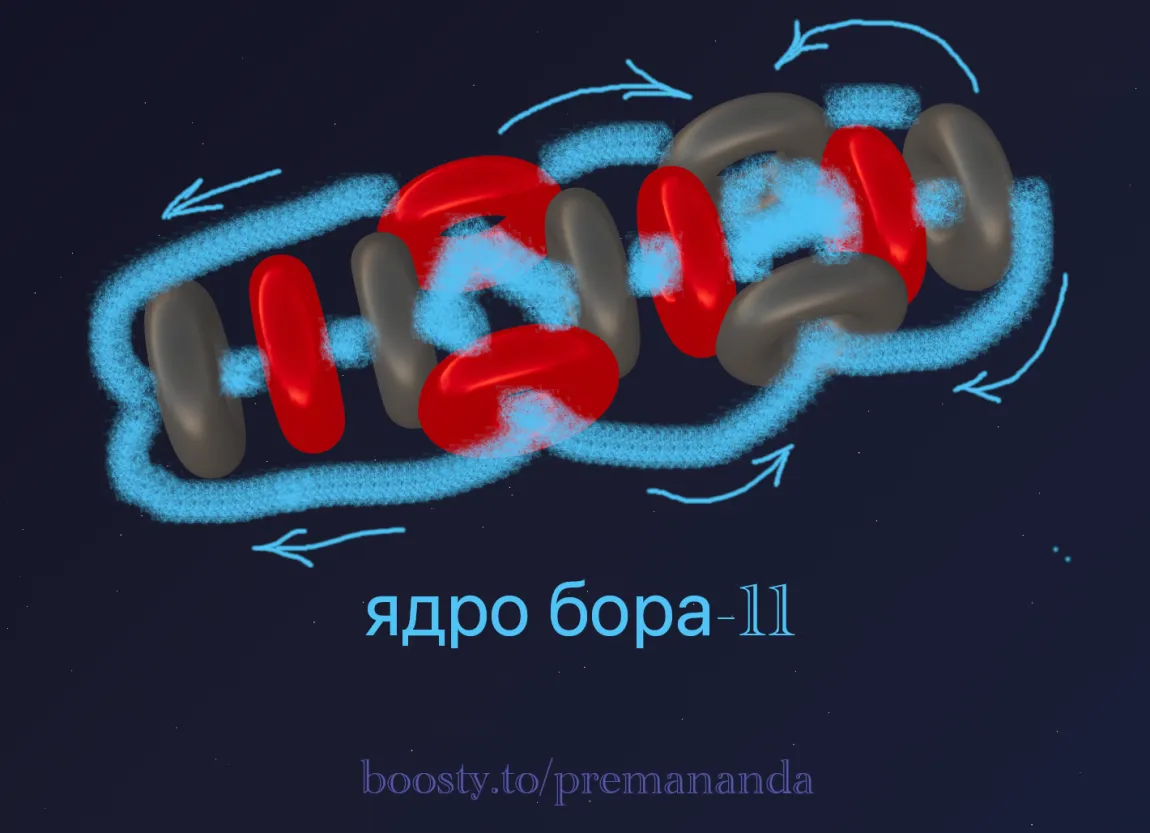
Key features of the configuration:
- Linear-spiral arrangement: Protons (red) and neutrons (gray) alternate along the central axis.
- Asymmetric configuration: Unlike the symmetric helium, the boron structure is asymmetric.
- Aether flows (blue arrows): Form a closed circulation system, creating a “hydrodynamic tie” that holds the structure together.
⚡ Why Does Boron-10 Absorb Neutrons So Readily?
This is one of the most fascinating questions! Boron-10 acts like a “neutron sponge.”
Reaction:
¹⁰B + n → ⁷Li + ⁴He (α) + 2.79 MeV
When a neutron enters ¹⁰B, the structure is destabilized and splits into lithium-7 and an alpha particle, releasing energy.
🧲 Nuclear Spin and Magnetic Properties
| Isotope | Spin | Magnetic moment |
|---|---|---|
| Boron-10 | 3 | 1.8006 μₙ |
| Boron-11 | 3/2 | 2.6886 μₙ |
🎨 Electron Shell
Boron has the electron configuration: 1s² 2s² 2p¹. Its three outer electrons define its chemical properties:
- Forms covalent bonds (B₂O₃, BF₃)
- Typical valence of 3
- Exhibits non-metallic properties
Aether Dynamics Interpretation
According to the aether dynamics model, electrons are generated by the nucleus itself — as vortex shells arising from the circulation of aether. This mechanism is discussed in detail in Part 1 of the series. As applied to boron:
- First shell (1s²): 2 electrons form in the near aether flows around the nucleus.
- Second shell (2s² 2p¹): 3 electrons arise in more distant circulation zones.
The outermost electron (2p¹) is the least bound to the nucleus and readily participates in chemical bonding.
🛠️ Build Your Own Model!
Want to experiment with boron’s nuclear configuration? Try the online atom constructor:
Try:
- Building an alternative model of boron-10.
- Comparing the stability of different configurations.
🤔 Open Questions
- Why did nature “prefer” boron-11? Why is 80% of natural boron ¹¹B rather than the symmetric ¹⁰B?
- The transition to carbon. How will adding one more proton and neutron change the configuration?
- Formation of electron shells. How exactly does the geometry of the nucleus determine how many electron shells it generates, and what shape they take?